

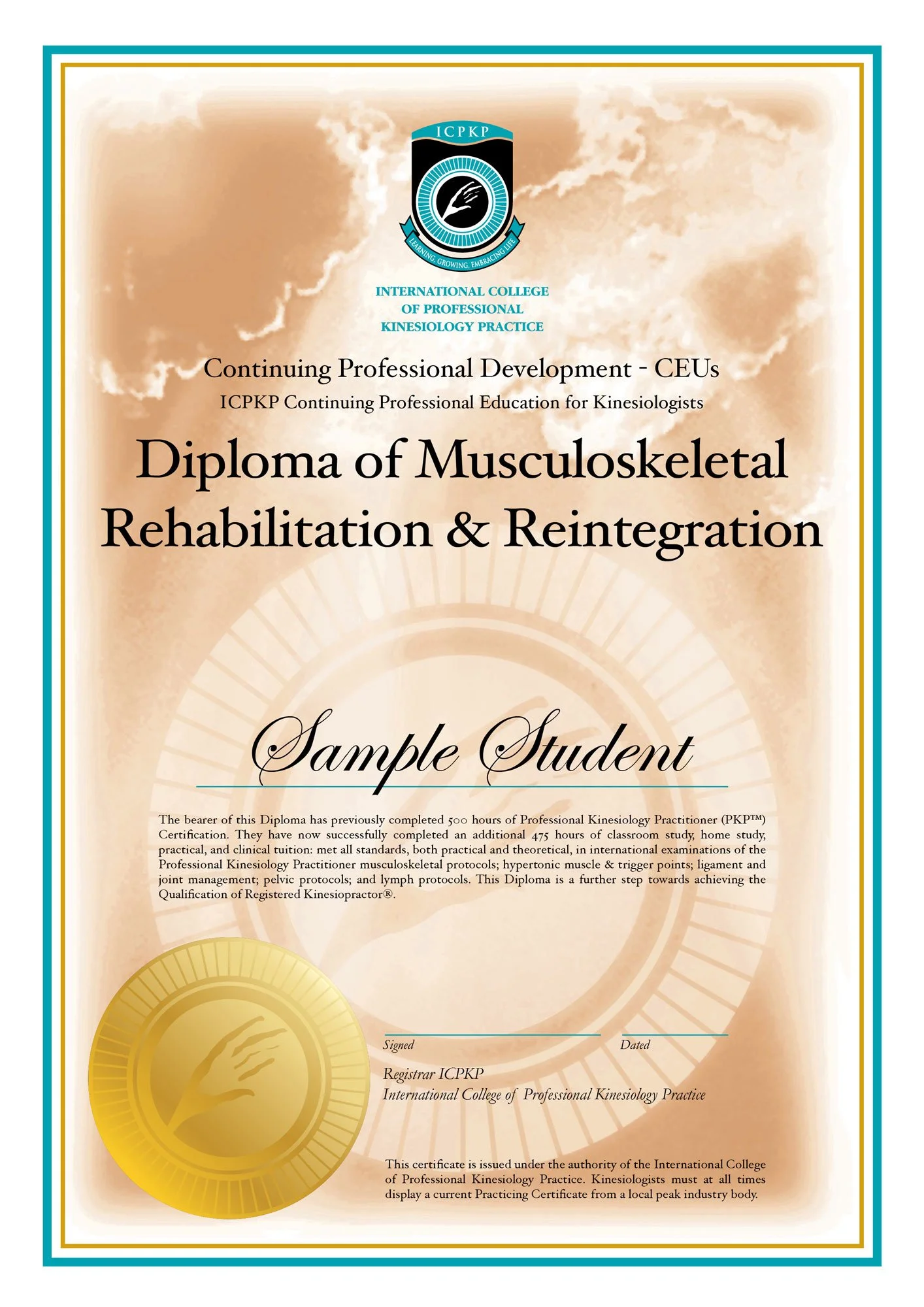
Diploma of Musculoskeletal Rehabilitation and Reintegration
Become the consummate professional clients recommend for limiting muscular pain and function.
This Diploma covers a wide range of structural techniques including:
BVL - Blood and Lymph Protocols.
There are 2 modules in this series that include balancing the autonomic nervous system, hiatus hernia, blood vessels, the lymphatic system and lymph flow in the neck, sinuses, eustachian (ear), breast and let as well as retrograde lymph.
PDG - Pelvic Protocols, Uterine Lift and Sacral Balancing.
There are 2 modules in this series that include pelvic postures, dural torque, pelvic and shoulder gaits, sacral wobble and universal sacral fault.
JAF - TMJ, Cranial, Ligament and Joint Protocols.
There are 3 modules in this series that include cranial bones and occiput balancing, TMJ balancing, shock absorbers, ligament stretch and general adrenal involvement with joints and muscles.
MST - Muscle Integration and Skin Activation Protocols.
There are 6 modules in this series, 4 of those modules are regional balancing protocols, shoulder/elbow/wrist/hand, hip/knee/ankle/foot, torso/back/neck/face as well as emotional anatomy, overbound anger responses and underbound despair responses, complex emotional layering responses, somatic interactions, amygdala and emotional intelligence.
HMR - Hypertonic Muscles and Trigger Points.
There are 4 modules in this series that focus on the study of hypertonic muscle release that will enable you to safely and comfortably release overtight muscles and any hypertonic emotional metaphors. We also focus on myofascial trigger point syndrome and correcting energy imbalance in trigger points.
Deeply embedded or submerged emotions can cripple us with pain or restricted movement.
Some people with trauma (physical/mental/emotional) express this as muscle hypertonicity, causing spasticity, so walking, talking, & sitting are difficult, and it can also be expressed as learning disorders.
You will also learn:
True functional anatomy.
New tools related to muscles and skin.
Being out-of touch, losing touch and how certain clothing affects our self-worth and emotional perspective.
Conquer hyper irritable spots in skeletal muscles (trigger points) and their referred pain patterns.
Clear TMJ and other joint pain, do shock absorber work, ligament interlink, strain & counter-strain.
Relieve sacro-iliac joint stress causing pelvic postures, debilitating neck & low back pain.
Alleviate humiliating stress incontinence, prolapsed bladder, bowel and sexual dysfunction.
Work with longitudinal and circular muscles of blood vessels & viscera to clear congested vital lymph flow.
Facilitate throat and breast lymph release, plus teaching self care will bring lots of referrals and clients to your clinic.

Course - Diploma of Musculoskeletal Rehabilitation & Reintegration
PKP Level 5 - Diploma 4
BEGINNING - 2027
Duration: 17 x 2 Day Workshops.
Offered as weekend classes.
Prerequisites:
International Certificate of Professional Kinesiology Practice (Foundation Principles).
This Qualification Includes (full module details are contained in the Handbook):
-
MST201 - Muscle Integration & Skin Activation Protocols
MST202 - Shoulder, Elbow, Hand Muscle Protocols
MST203 - Hip, Leg, Foot Muscle Protocols
MST301 - Head, Neck, Torso Muscle Protocols
MST302 - Touch, Clothes and Environment Protocols
MST303 - Emotional Anatomy and Emotional Intelligence
-
HMR201 - Hypertonic Muscle Release Basic
HMR301 - Hypertonic Release – Arms and Legs
HMR302 - Hypertonic Release – Head, Neck, Torso
RBT301 - Trigger Points
-
JAF201 - Temporomandibular Joint & Cranial Protocols
JAF301 - Ligament and Joint Protocols
JAF302 - Inflexibility, Injury and Strain Protocols
-
PDG301 - Pelvic Postures and Sacral Balancing
PDG302 - Pelvic Diaphragm – Uterine Lift
-
BVL301 - Valves, Viscera and Blood Vessels
BVL302 - Breast and Other Lymph Clearing
-
Elements of Learning:
What is stress?
Dr. Selye’s three stages of stress
Warning signs of stress
How the body responds to stresss
The Holmes-Rahe life-event test
What is Emotional stress release (ESR)?
Doing Emotional stress release (ESR)
Whole Body Testing
Accurate Muscle (clear circuit) Testing
Emotional balancing with affirmations
Alarm points – diagrams
Meridians & emotions – positive and negative
Using affirmations with muscle testing
General stress syndrome
Breathing and stress management
Exercise and stress management
Nutrition and stress management
Food supplements and stress management
Long-term stress management
Humour and stress management
-
Elements of Learning:
The Essence of Epigenetics
The Basics of Epigenetics
Taking Control of your Epigenetic Modulation: The Balancing Process overview
Lists of Common Universal Fears, Job Stresses and Relationship Issues
Whole Body Self-Testing
Accurate Muscle Testing – using Anterior Deltoid – when working with another
General Circulation of Energy Wheel
Meridian Emotions (negative & positive)
ICPKP’s Five Element Emotion Chart
Resilience Cycle & Stress Tolerance points (also known as NEs)
Vesuvius Cycle & Tension Release valves (also known as Accumulation points)
Self-soothing Cycle & Soothing and Calming reflexes (also known as NVs)
Lymphatic Flush Cycle & Muscle Pain Release & Energy Boost points (also known as NLs)
Chi (chee) Meridian Cycle & Meridian Tracing
-
Elements of Learning:
Learn Tibetan energy skills
Figure 8 energy flow – overview
Whole Body – Self-testing
Accurate muscle testing
Overall Figure 8 energy test (fuzzy glove)
The four large figure 8s
The twelve smaller figure 8s
The two small 8s on the top of the head and the soles of the feet:
Figure 8s at other sites
Whole body 8s for learning disorders
The healing effect of sound
Spiral energy flow above the head
The spinning vortices
The Five Tibetan Vitality Exercises
Origin of the Five Tibetan Rites; The Scientific Evidence
Nutrition for energy, stamina and vitality, and the McGovern Report
Supplements for energy, stamina and vitality
Tibetan meridian activation
-
Taken with an external provider for an additional cost.
Your Investment:
The full course fee is $12,750
There are two methods of payment:
Pay the course fee in full. Requires a deposit of $6,375.00 to be paid upon enrolment and the remainder of $6,375.00 payable 1 month later.
Pay the course in instalments. This requires a $750.00 deposit to be paid upon enrolment with 16 monthly instalments of $750 payable each month.
Specialised payment plan. A specialised payment plan can be arranged with Bianca at a fee of $150.00.
Course Payment Adjustment: The Diploma units SPM101, SPM102, SPM103 and OCT302 modules are part of all 4 Diplomas. These modules are not part of the cost of the Diploma of Dietary and Nutritional Science. If you have not completed these modules as part of another Diploma then the cost of completing these modules will needed to be added.
FAQ’s
-
Yes, you must have successfully passed the International Certificate in Professional Kinesiology Practice which is the first 12 months of PKP training encompassing the Foundational principles of PKP.
-
Yes absolutely. Some of the units that are included in the Diploma of Energy Psychology are also contained in the previous legacy structure of PKP, such as the International Diploma of Kinesiology, so you will be credited for those units you have attended and received competency for.
-
All units are taught face to face with the capability to move studies partially online if needed.
All class notes, assessment journals and extra resources are provided online via the ICPKP app which has been specifically designed for easy access and learning.
-
Each unit contains a set of class notes and a SAJ (Student Assessment Journal) which needs to be completed. There is a short online multiple-choice test after every unit which is open book and a practical assessment at the end of the course which you will facilitate on a fellow student.
-
We highly encourage students to attend all classes as the syllabus is a follow-on modality which means that you will continue working with the previous learned techniques as part of the next module.
We also understand that life events happen so a private tutorial would need to be arranged in order for you to catch up at the students expense..
Classes are not scheduled on public holidays, long weekends and school holidays to ensure that you are available to attend all units.
-
You will need an iPad as the course curriculum is delivered via the ICPKP app.
-
The School of Elemental Kinesiology is a school born from over 16 years as an advanced and specialised practitioner, 12 years as a senior Kinesiology teacher, FAC3 PKP certified, as well as many years of personal self-development, trauma healing, attachment therapy and continuous learning and studying.
Bianca is a qualified Kinesiopractor® after completing the full 4-year PKP syllabus. She then became a PKP teacher in 2012 and has taught thousands of students the full 4 years of PKP Kinesiopractor® training.
Bianca is also a registered Clinic Supervisor and Mentor with the AKA (Aust.Kinesiology Association) and a registered Clinic Mentor with the AIK (Aust. Institute of Kinesiology). Bianca is also a certified Trainer & Assessor which is a requirement to teach a registered Diploma or Advanced Diploma qualification.
Bianca has also trained in TBM (Total Body Modification), Quantum Neurology, Advanced Glands & Hormones and is an initiated Shamanic Magician and Teacherwith The White Dragon Lineage as part of Shamanic Energy Training after completing 6 years of full time study and she still receives ongoing mentoring.
-
Absolutely, you can contact me and I will organise a time to have a chat and answer any further questions you may have.
Please ensure that you have downloaded and read the course brochure first.